Benison Moore
The Knife of Never Letting GoBenison Moore is one of the two men who raise Todd Hewitt after the Noise germ and the war leave New World’s surviving communities struggling to care for a generation of children. A farmer, a former Church settler, and a quiet source of protection, Ben becomes crucial to Todd’s departure from home: he gives him his mother’s journal, warns him that his understanding of the world is false, and orders him to escape rather than turn back. His care is practical and intimate, but it cannot spare Todd the pain of leaving.
Identity and Life on the Farm
Ben lives and works alongside Cillian Boyd on a farm where planting is finished and the wheat harvest is still months away. The immediate work includes keeping the generators, fission tractor, and electric threshers ready; Todd observes that this lull in the wheat work does not bring him any help with the sheep. The farm is therefore both a household and a working place, its machinery and animals part of the ordinary life from which Todd is about to be driven.
Todd distinguishes Ben from Cillian through the quality of their Noise. Ben’s seems calmer and clearer: although Noise cannot actually be seen, Todd imagines it as blue or sometimes green, in contrast to the reddish impression Cillian gives him. The difference is not merely visual. Todd calls the two men different as fire and water, and describes them together as his “more or less parents.” The phrase acknowledges a family made through care rather than birth, while the contrasting colors and temperaments preserve the individuality of the two men who share that care.
The Settlement and Todd’s Upbringing
The story Todd has heard is that his mother and Ben were friends before they left for New World, and that both belonged to the Church when the opportunity to establish a settlement arose. Todd’s mother persuaded his father to go; Ben persuaded Cillian. After the ships landed, Todd’s parents raised sheep on the neighboring farm while Ben and Cillian grew wheat. In Todd’s remembered version of the settlers’ early life, the farms were friendly, men and women sang together, and people lived without sickness or death. He immediately qualifies that account: it comes from Noise, so he cannot know how much of it describes the past as it really was.
The catastrophe that followed gives Ben’s parental role its stakes. The Spackle released a germ that killed women; war followed, and Todd understands that the losses left roughly half a town of men to care for babies and boys. Many children died. Ben and Cillian took Todd in, fed him, raised him, and taught him, making it possible for him to survive. Ben’s place in Todd’s life is thus established not by a single rescue but by sustained care in the aftermath of a community-wide disaster.
The Warning and the Departure
When Mr Prentiss Jr arrives, he identifies the men and Todd through the door by name: “Benison Moore. Cillian Boyd. Todd Hewitt.” The call makes concealment impossible. As Cillian goes to the door, Ben packs a sack of food into Todd’s rucksack and hands it to him. This swift preparation precedes the more difficult part of the farewell: Ben gives Todd a book, and Todd admits that he does not read well. Ben explains that it is Todd’s mother’s journal, begun on the day Todd was born and continued until the day she died. The object connects Todd to a mother he lost in infancy and to a past he cannot independently remember.
Ben’s next disclosure is deliberately incomplete. He tells Todd that the things he believes are not true, but refuses to explain what is hidden. When Todd presses him, Ben says that knowledge is dangerous: if the truth were spoken there, it would become conspicuous in Todd’s Noise, and Mayor Prentiss would find him quickly. He therefore couples the warning with an urgent instruction to get as far away as possible. Ben’s silence is not presented as indifference; within the scene, it is a protective measure shaped by the danger of being overheard through Noise.
Separation and Narrative Role
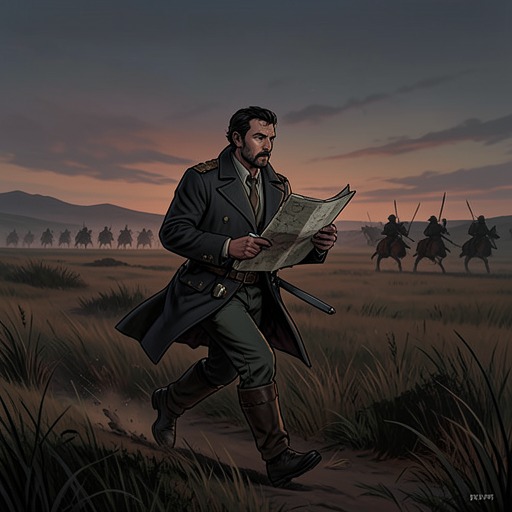
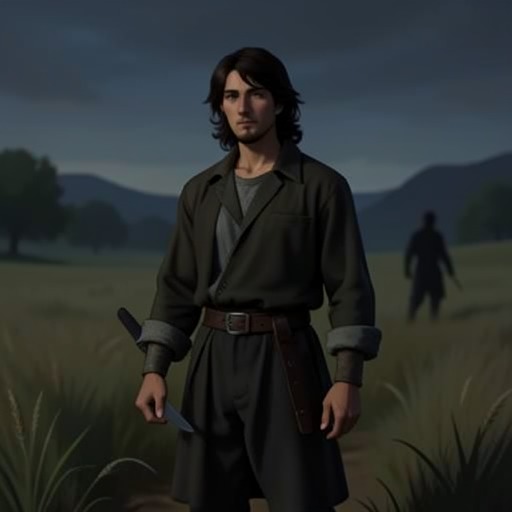
A further bang from the farm turns the warning into immediate action. Ben holds out a knife, and Todd takes it, admitting that he has never fought a Spackle before. Ben directs him to follow the river down to the swamp and out, run fast, and not turn back. He grips Todd’s arm and promises, “If I can find you, I’ll find you, I swear it.” The promise is paired with a demand that Todd keep going and keep his own promise. Ben is both sending him away and trying to preserve a bond across the separation; the route, the knife, and the rucksack make that care tangible.
The scene closes not with a settled farewell but with Todd recognizing that this is goodbye, a goodbye he had not sought. Ben’s importance lies in the collision between parental tenderness and necessary refusal: he offers food, a journal, a weapon, and the possibility of reunion, but not the full explanation Todd wants. Because Todd narrates the episode from his limited understanding, Ben’s warning also establishes a gap between what the boy believes and what the adults know. The immediate result is departure; the deeper truth Ben withholds remains part of the danger Todd must carry with him.